Far From Care: Brain Injury in Rural America
Categories: THE Challenge!
By Lauren Moore, Marketing and Communications Manager, Brain Injury Association of America
In November 2021, Tim Chiarolanza was settling into his new role as the strength and conditioning coach at Lycoming College – a private, liberal arts college nestled in a rural part of central Pennsylvania among the Appalachian Mountains. Lycoming was Chiarolanza’s alma mater, situated in a small town called Williamsport that had come to feel like home for him.
On November 16, Chiarolanza was walking his dog, Finn, through Williamsport, when he ran into a few Lycoming students who were on their way to watch a basketball game at nearby Lock Haven University. The students stopped to talk to “Coach Tim,” but as they started to leave, Finn chased after them. His leash broke, and Finn darted into oncoming traffic. Chiarolanza instinctively chased after his pet and was struck by a car traveling 40 miles per hour. “The dog is completely alright,” Chiarolanza is quick to point out when sharing his story.
Chiarolanza, however, was not. The collision launched him into a parked pickup truck and left him with several injuries, including a ruptured aorta, several broken bones, a separated pelvis, a collapsed lung, and a severe traumatic brain injury. The students he had been speaking with sprang into action, diverting traffic as best they could and calling 911. An ambulance brought Chiarolanza to the nearest hospital, University of Pittsburgh Medical Center-Williamsport, about two miles away from the site of the accident. At the time, UPMC-Williamsport was a non-trauma hospital; it lacked the necessary specialists and resources to treat Chiarolanza’s extensive and life-threatening injuries. The nearest hospital with those resources – Geisinger Medical Center in Danville – was more than 35 miles away, far enough that Chiarolanza would not have survived the ambulance ride. Fortunately, he was able to be airlifted by Guthrie Air, a medical air transport service that provides critical care helicopter services. “Without them, I would not be alive today,” Chiarolanza said.
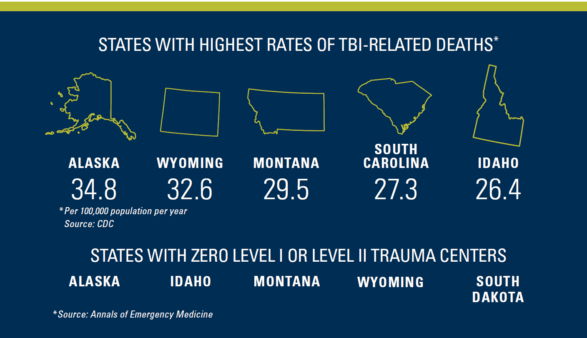
Chiarolanza’s circumstances are not unusual. Twenty percent of the U.S. population lives in a rural area, according to 2020 census data. As many as 30 million Americans do not have access to a Level I or Level II trauma center within an hour of where they live. As a result, people living in rural areas are more likely to die from a traumatic brain injury than those living in urban or suburban areas. There are a number of reasons for this disparity, including the increased time needed to travel to emergency medical care, less access to Level I trauma centers (the highest level of medical care), and difficulty accessing services like specialized TBI care.
While the common causes of brain injuries in these areas are not unlike those in urban or suburban areas – motor vehicle accidents are a leading cause of TBI – the need for residents to travel longer distances than their urban or suburban counterparts are contributing factors. And because rural areas often have poor broadband access, telemedicine and remote monitoring can be difficult or even impossible.
Further limiting rural Americans’ access to care are hospital closures. Between 2005 and 2023, 146 hospitals in rural U.S. counties closed or stopped providing inpatient services, according to the United States Department of Agriculture. The main driver of hospital closures was financial stress, with contributing factors including their smaller size, lower occupancy rates, and greater susceptibility to economic fluctuations than urban hospitals.
For patients like Chiarolanza – those in rural areas who are prohibitively far from a Level I trauma center and whose injuries require immediate, specialized care – medical air transport can mean the difference between life and death. For those who have sustained a TBI – as well as those who sustain anoxic brain injuries as a result of stroke or a cardiac issue – the faster they receive care, the better their chances are of surviving the injury and preserving brain function.
To be sure, air ambulances play a critical role in responding to patients who have sustained a brain injury. Yet the air medical industry faces challenges, including high costs of operation and outdated rates for Medicare and Medicaid reimbursement, that put their ability to serve rural populations in jeopardy.
“On the day of my accident, Guthrie Air was actually third or fourth down the list. They weren’t first. But all the other helicopters were on calls already,” Chiarolanza shared. “So, if you don’t have those air ambulances … like I said, I wouldn’t have survived without it. I wouldn’t have survived a 45-minute ambulance ride to my Level I Trauma Center to have my surgeries.”